eviden-logo

Evidian > Products > SafeKit: All-in-One SANless High Availability & Application Clustering Software > VM HA vs Application HA

VM HA vs Application HA

Evidian SafeKit

SafeKit: High Availability (HA) and Redundancy Choices

What are the two primary choices for ensuring high availability and redundancy?

You can choose between setting up redundancy:

  • At the application level
  • At the virtual machine (VM) level

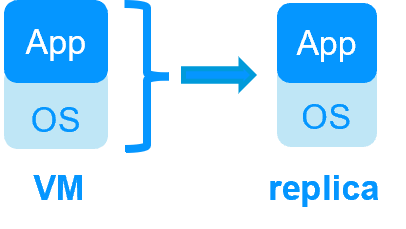
What is "Redundancy at the application level"?

In this solution, only the application data are replicated. In the event of a failure, only the application is restarted, not the entire operating system or VM.

SafeKit diagram for Application Level High Availability (HA): Illustrates synchronous replication of critical application data between active and passive servers, enabling fast application failover without needing a full VM restart.

Technical Requirements:

  • It requires a technical understanding of the application itself.
  • You must manually define:
    • Which services need to be restarted.
    • The specific application folders that need real-time replication.
    • The configuration of a virtual IP address for failover.

Platform Compatibility:

  • This solution is platform-agnostic.
  • It works inside physical machines, virtual machines, or in the Cloud.
  • Any hypervisor is supported (e.g., VMware, Hyper-V, etc.).
  • More information: Windows, Linux

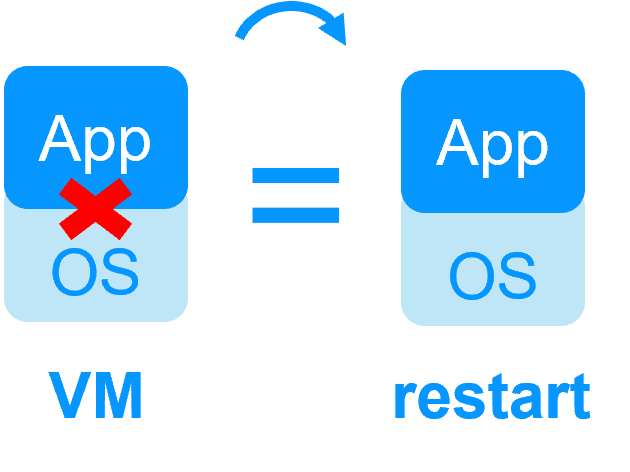
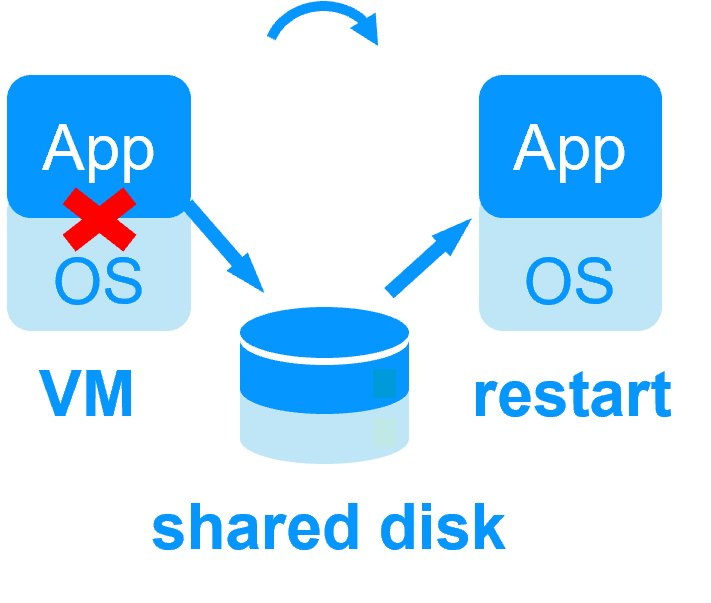
What is "Redundancy at the virtual machine (VM) level"?

In this solution, the full Virtual Machine (VM) is replicated, including both the Application and the Operating System (OS). In the event of a failure, the full VM is restarted.

SafeKit diagram for Virtual Machine (VM) Level High Availability (HA): Illustrates the full replication of the VM, including the OS and application, between two physical servers to ensure service continuity upon hardware failure.

Key Advantages:

  • It does not require a technical understanding of the application installed within the VM.
  • It is the best solution if you do not know how the application works.
  • You only need to define the location of the VM files.

Platform Compatibility:

  • This solution works with Windows/Hyper-V and Linux/KVM.
  • It does not support VMware for this type of redundancy.
  • This is typically an active/active solution where several virtual machines can be replicated and restarted between two nodes.
  • More information: Windows/Hyper-V, Linux/KVM

VM HA vs Application HA

VM HA with the SafeKit Hyper-V or KVM module Application HA with SafeKit application modules
SafeKit inside 2 hypervisors

VM HA

SafeKit replication and failover of full VM

SafeKit inside 2 virtual or physical machines

Application HA

SafeKit replication and failover at application level

Replicates more data (App+OS) Replicates only application data
Reboot of VM on hypervisor 2 if hypervisor 1 crashes
Recovery time = time to reboot the VM
Failover if a VM crashes
Quick recovery time with restart of App on OS2 if crash of server 1
Around 1 mn or less (see RTO/RPO here)
Advanced application checker and software failover
Define the location of the VM files folder where the application is installed. Generic solution for any application / OS Define services to restart, application folders to replicate, a virtual IP address for failover inside an application module
The solution works with Hyper-V and KVM but not with VMware (except by nesting Hyper-V or KVM inside VMware) The solution works in any infrastructure (physical servers, VMware Hyper-V KVM virtual machines, cloud...)

SafeKit vs Microsoft Hyper-V Cluster & VMware HA

SafeKit with the Hyper-V module or the KVM module Microsoft Hyper-V Cluster & VMware HA
SafeKit with Hyper-V VMware HA and Hyper-V cluster

Note that SafeKit solutions are the simplest to implement but are limited to replication of a few Tera-bytes and failover of 32 VMs.

🔍 SafeKit High Availability Navigation Hub

Explore SafeKit: Features, technical videos, documentation, and free trial
Resource Type Description Direct Link
Key Features Why Choose SafeKit for Simple and Cost-Effective High Availability? See Why Choose SafeKit for High Availability
Deployment Model All-in-One SANless HA: Shared-Nothing Software Clustering See SafeKit All-in-One SANless HA
Partners SafeKit: The Benchmark in High Availability for Partners See Why SafeKit Is the HA Benchmark for Partners
HA Strategies SafeKit: Infrastructure (VM) vs. Application-Level High Availability See SafeKit HA & Redundancy: VM vs. Application Level
Technical Specifications Technical Limitations for SafeKit Clustering See SafeKit High Availability Limitations
Proof of Concept SafeKit: High Availability Configuration & Failover Demos See SafeKit Failover Tutorials
Architecture How the SafeKit Mirror Cluster works (Real-Time Replication & Failover) See SafeKit Mirror Cluster: Real-Time Replication & Failover
Architecture How the SafeKit Farm Cluster works (Network Load Balancing & Failover) See SafeKit Farm Cluster: Network Load Balancing & Failover
Competitive Advantages Comparison: SafeKit vs. Traditional High Availability (HA) Clusters See SafeKit vs. Traditional HA Cluster Comparison
Technical Resources SafeKit High Availability: Documentation, Downloads & Trial See SafeKit HA Free Trial & Technical Documentation
Pre-configured Solutions SafeKit Application Module Library: Ready-to-Use HA Solutions See SafeKit High Availability Application Modules
FAQ Frequently Asked Questions on Architecture, Technical specs, Features See SafeKit HA FAQ