


Virtual IP address in a farm cluster

On the previous figure, the Windows application is running on the 3 servers (3 is an example, it can be 2 or more). Users are connected to a virtual IP address.
The virtual IP address is configured locally on each server in the farm cluster.
The input traffic to the virtual IP address is received by all the servers and split among them by a network filter inside each server's kernel.
SafeKit detects hardware and software failures, reconfigures network filters in the event of a failure, and offers configurable application checkers and recovery scripts.
How to configure a SafeKit farm cluster?
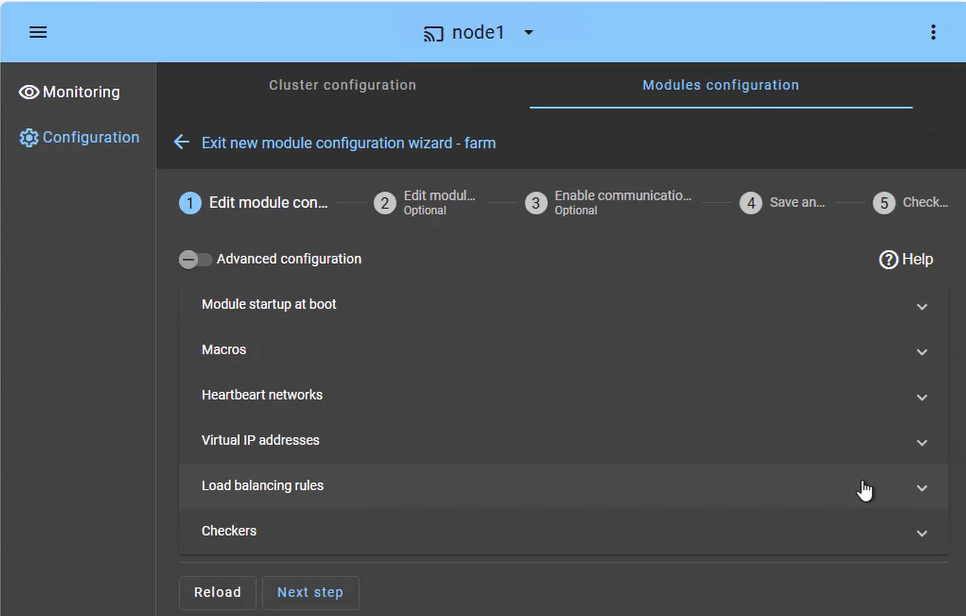
The SafeKit farm cluster is designed for high availability and scalability of services. The configuration focuses on distributing incoming traffic across both nodes simultaneously:
- Load Balanced Services (Macros tab): Define the specific application services (e.g., Apache, IIS, Nginx) to be kept active on all nodes.
- Heartbeat network(s): Communication path(s) used to detect if a node has left the farm, triggering an immediate redistribution of the load.
- Virtual IP (Farm VIP): Unlike a mirror cluster, the Farm VIP is shared between nodes using kernel filtering algorithm to distribute network traffic.
- Load Balancing Rules: Define the traffic distribution policy based on the source IP address or port.
- Checkers: Monitor the application's health and trigger automatic restart if a process failure is detected.
How to monitor a SafeKit farm cluster?
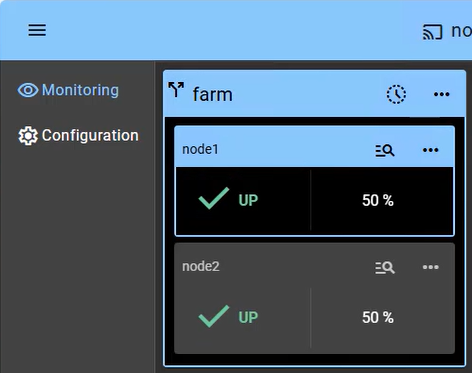
Monitoring a farm cluster provides visibility into the Active-Active nature of the infrastructure, where all nodes contribute to the application's performance (showing 2 nodes in this example):
- UP State (50% on 2 nodes): In a healthy farm, both nodes are in the "UP" (50%) state, meaning they are both actively receiving and processing client requests via the shared Virtual IP.
- Automatic Re-balancing: If one node fails, the console visually shows the remaining node taking 100% of the traffic. There is no "failover" delay, as the surviving node is already active (aside from a detection time of a few seconds).
- Node Insertion: When a repaired node is restarted, it transitions from "STOP" to "UP" and automatically starts receiving its portion of the load without administrator intervention.
- No Data Sync: Note that in a farm cluster, there is no "Orange" resynchronization state, as nodes are expected to be stateless or share a backend database (which can be protected separately in a mirror cluster).
Beyond simple status icons, the interface provides one-click node management, allowing you to manually stop or start a node for planned maintenance while the shared Virtual IP automatically redistributes traffic without interrupting user activity.