eviden-logo

Evidian > Products > SafeKit: Simple, Cost-Effective High Availability Software > Best/Worst Use Cases of High Availability

Best/Worst Use Cases of High Availability

Evidian SafeKit

Best use cases of SafeKit high availability

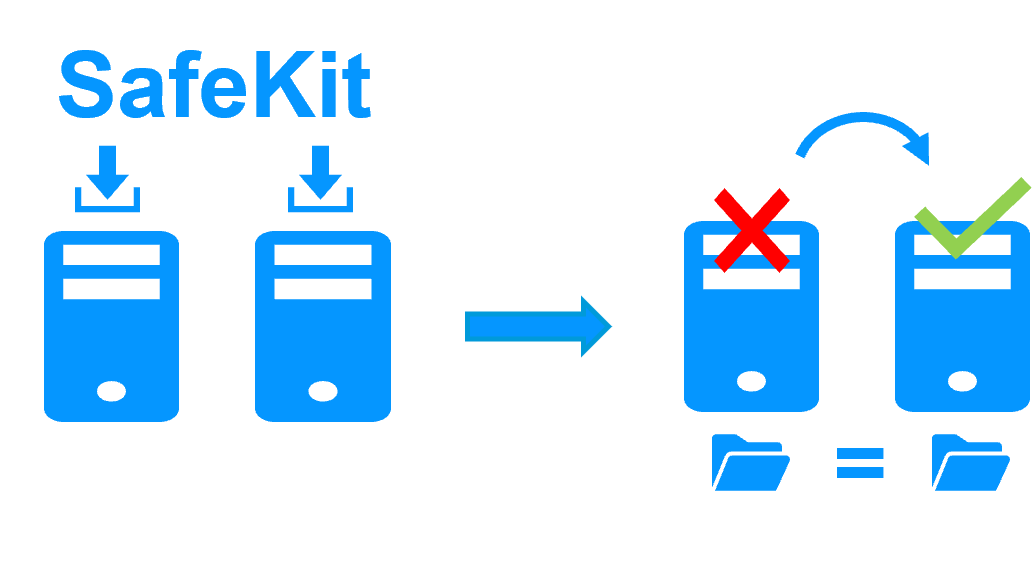
OEM Software

A software publisher uses SafeKit as an OEM software for high availability of its application

Application Clustering Software for a Software Publisher

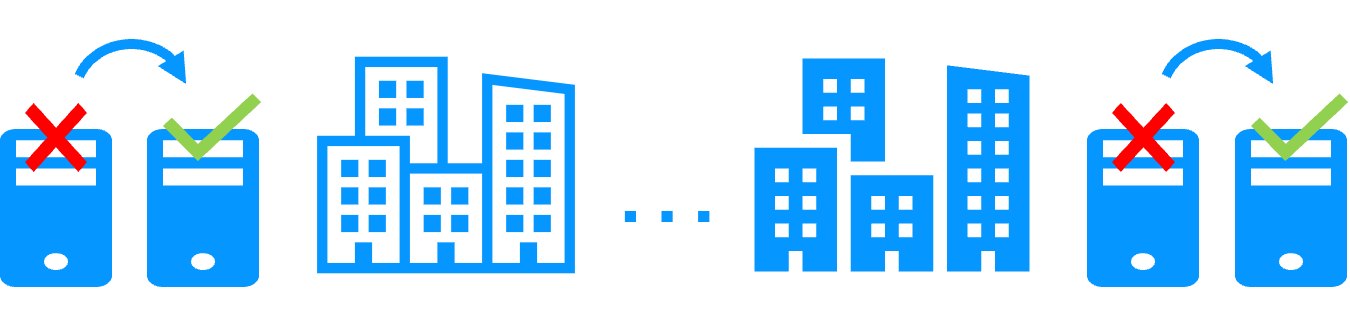
Distributed Enterprise

A distributed enterprise deploys SafeKit in many branches without specific IT skills

High Availability Software in a Distributed Enterprise

Remote Sites

SafeKit is deployed in two remote sites without the need for replicated bays of disks through a SAN.

Business Continuity and Disaster Recovery without a replicated SAN

Worst use cases of SafeKit high availability

Typical usage with SafeKit

Why a replication of a few Tera-bytes?

Resynchronization time after a failure (step 3)

  • 1 Gb/s network ≈ 3 Hours for 1 Tera-bytes.
  • 10 Gb/s network ≈ 1 Hour for 1 Tera-bytes or less depending on disk write performances.

Alternative

Why a replication < 1,000,000 files?

  • Resynchronization time performance after a failure (step 3).
  • Time to check each file between both nodes.

Alternative

  • Put the many files to replicate in a virtual hard disk / virtual machine.
  • Only the files representing the virtual hard disk / virtual machine will be replicated and resynchronized in this case.

Why a failover ≤ 32 replicated VMs?

  • Each VM runs in an independent mirror module.
  • Maximum of 32 mirror modules running on the same cluster.

Alternative

  • Use an external shared storage and another VM clustering solution.
  • More expensive, more complex.

Why a LAN/VLAN network between remote sites?

Alternative

  • Use a load balancer for the virtual IP address if the 2 nodes are in 2 subnets (supported by SafeKit, especially in the cloud).
  • Use backup solutions with asynchronous replication for high latency network.

Comparison of SafeKit with Traditional High Availability (HA) Clusters

How does SafeKit compare to traditional High Availability (HA) cluster solutions?

This comparison highlights the fundamental differences between SafeKit and traditional High Availability (HA) cluster solutions like Failover Clusters, Virtualization HA, and SQL Always-On. SafeKit is designed as a low-complexity, software-only solution for generic application redundancy, contrasting with the high complexity and specific storage requirements (shared storage, SAN) typical of traditional HA mechanisms.
Comparison of SafeKit with traditional High Availability (HA) clusters
Solutions Complexity Comments
Failover Cluster (Microsoft) High Specific Storage (shared storage, SAN)
Virtualization (VMware HA) High Specific Storage (shared storage, SAN, vSAN)
SQL Always-On (Microsoft) High Only SQL is redundant, requires SQL Enterprise Edition
Evidian SafeKit Low Simplest, generic and software-only. Unsuitable for large data replication.

SafeKit's Advantage in Application Redundancy

SafeKit achieves its low-complexity High Availability through a simple, software-based mirroring mechanism that eliminates the need for expensive, dedicated hardware like a SAN (Storage Area Network). This makes it a highly accessible solution for quickly implementing application redundancy without complex infrastructure changes.

SafeKit: The Benchmark in High Availability for Partners

How does SafeKit contribute to our partners' customer success?

This platform-independent software is ideal for partners reselling critical applications who need to offer customers a simple, cost-effective high availability (HA) and system redundancy option, without the complexity and expense of SANs (Storage Area Networks). SafeKit’s core features — load balancing, real-time data replication, and automatic failover — significantly simplify the integration of HA into any service or product offering.

Why is SafeKit the simplest high availability solution on the market?

With a proven track record and numerous deployments in over 30 countries through our extensive partner network, SafeKit is recognized as the easiest and fastest HA solution to implement for critical systems. This includes sectors like video management systems (VMS), access control, building management (BMS), SCADA software, automated logistics, and critical air/rail traffic control, ensuring maximum uptime across the board.

How does SafeKit accelerate partner mastery of HA deployment and support?

SafeKit offers a complete, free, and open-access resource kit to support its partners, including free trials, comprehensive online training modules, and the opportunity to obtain official SafeKit certification at no cost. These tools enable partners to rapidly acquire the necessary technical skills to effectively deploy and provide world-class support for the solution, minimizing deployment time and reducing the learning curve.

SafeKit Customers in all Business Activities

  • Best high availability use cases with SafeKit

    Best use cases [+]

  • High availability of video management, access control, building management with SafeKit

    Video management, access control, building management [+]

  • Harmonic has deployed more than 80 SafeKit clusters for TV broadcasting

    TV broadcasting [+]

  • Natixis uses SafeKit as a high availability solution for banking applications

    Finance [+]

  • Fives Syleps implements high availability with SafeKit for automated logistics

    Industry [+]

  • Air traffic control systems supplier, Copperchase, deploys SafeKit high availability in airports.

    Air traffic control [+]

  • Software vendor Wellington IT deploys SafeKit in banks

    Bank [+]

  • Paris transport company (RATP) chose the SafeKit high availability for metro lines

    Transport [+]

  • Systel deploys SafeKit in emergency call centers

    Healthcare [+]

  • ERP high availability and load balancing of the French army (DGA) are made with SafeKit.

    Government [+]

How the SafeKit mirror cluster works?

Step 1. Real-time replication

Server 1 (PRIM) runs the application. Clients are connected to a virtual IP address. SafeKit replicates in real time modifications made inside files through the network.

File replication at byte level in a mirror cluster

The replication is synchronous with no data loss on failure contrary to asynchronous replication.
You just have to configure the names of directories to replicate in SafeKit. There are no pre-requisites on disk organization. Directories may be located in the system disk.

Step 2. Automatic failover

When Server 1 fails, Server 2 takes over. SafeKit switches the virtual IP address and restarts the application automatically on Server 2.
The application finds the files replicated by SafeKit uptodate on Server 2. The application continues to run on Server 2 by locally modifying its files that are no longer replicated to Server 1.

Failover in a mirror cluster

The failover time is equal to the fault-detection time (30 seconds by default) plus the application start-up time.

Step 3. Automatic failback

Failback involves restarting Server 1 after fixing the problem that caused it to fail.
SafeKit automatically resynchronizes the files, updating only the files modified on Server 2 while Server 1 was halted.

Failback in a mirror cluster

Failback takes place without disturbing the application, which can continue running on Server 2.

Step 4. Back to normal

After reintegration, the files are once again in mirror mode, as in step 1. The system is back in high-availability mode, with the application running on Server 2 and SafeKit replicating file updates to Server 1.

Return to normal operation in a mirror cluster

If the administrator wishes the application to run on Server 1, he/she can execute a "swap" command either manually at an appropriate time, or automatically through configuration.

SafeKit: Technical Demonstrations and Tutorials

SafeKit High Availability Resources, Downloads, and Documentation

💡 To kickstart your high availability journey with SafeKit, begin with the Quick Installation Guides.

📦 SafeKit's HA Software Packages - Version 8.2

This table provides the SafeKit installation files for the current version, organized by operating system and installer type.

OS / Platform Installer Type Key Benefit Download Link
Windows (64-bit) .exe Installer Includes Microsoft VC++ Redistributable ⬇️ Download SafeKit 8.2 Windows EXE
Windows (64-bit) .msi Installer Does not include Microsoft VC++ Redistributable ⬇️ Download SafeKit 8.2 Windows MSI
Linux (64-bit) Auto-extractable .BIN Includes Linux package and installation script ⬇️ Download SafeKit 8.2 Linux BIN File

➡️ Go to v7.5 Archives